

An Easy Guide to Septic Systems
If you’ve had a soil profile or perk test done, you may wondering about the type of system the designer has recommended. While there are a multitude of variations and laws that depend on the property location I will attempt to cover the major types and how they operate.
Most of these systems require a soil test to size them properly. The sizing takes into account the occupancy of the house and the amount of water the soil will absorb.
You will notice a lot of these are simply variations of a similar design. Keep reading to understand each type and the pros and cons of each.

Conventional Subsurface System
Conventional subsurface absorption is known by many names: leach field, lateral lines, drain field and more. This is the type you probably think of when you hear the words ‘septic system’. It is a gravity fed subsurface distribution system.
The septic tank used should be at least 1000 gallons and can be a tank with a single compartment or divided into two compartments. A line is ran from the tank to the distribution field.
Most areas require an effluent filter on the tank outlet.
The subsurface lines are excavated and either perforated pipe with gravel or a manufactured system like chambers are laid in the trenches. The trenchers are then covered with either the native soil or soil brought in for that purpose.
Grass should be the only thing planted above the lines and you should avoid driving on them.
Conventional Septic System Pros
- Lower maintenance cost (no moving parts)
- Can handle lower flows (less than 100 gpd) better
- Will last 40+ years with proper maintenance
- Low flow systems may be less expensive than other options.
Conventional Septic System Cons
- Maintenance is often ignored
- Large footprint
- High flow systems may be more expensive than other options

-

- A septic with perforated pipe.

-

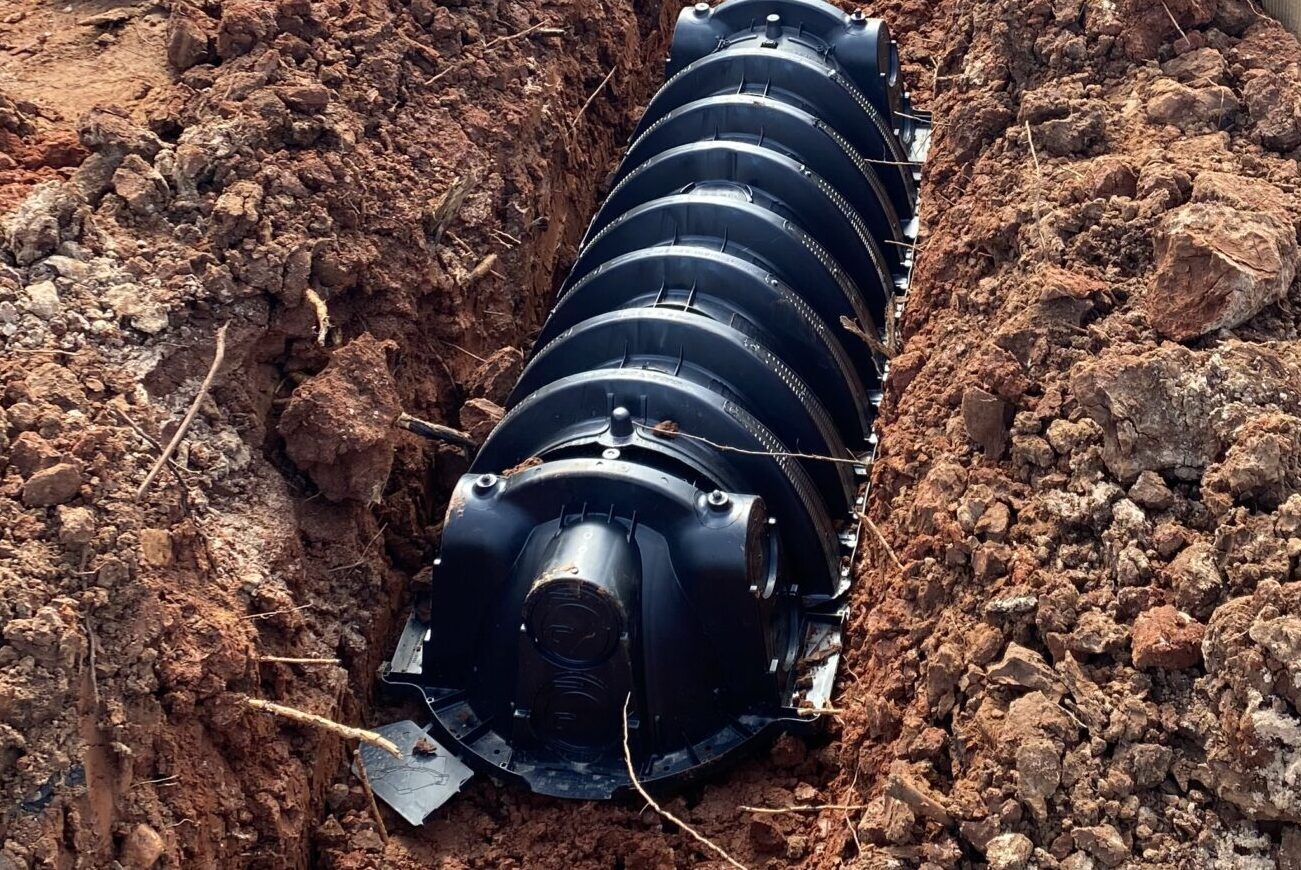
- A septic with chambers.
Low Pressure Dosing
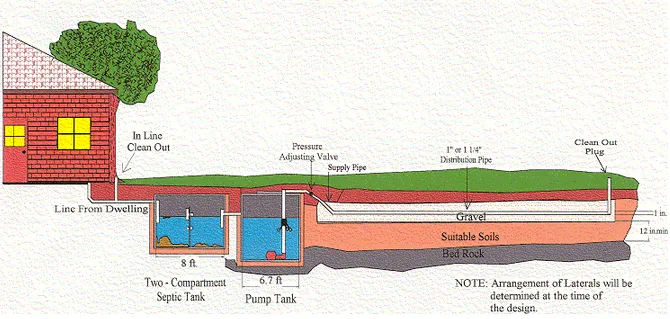
A Low Pressure Dosing (LPD) septic system is a specialized wastewater treatment solution for challenging sites with poor soil conditions, shallow water tables, or limited space. It consists of a septic tank, dosing chamber, and a network of small-diameter pipes that distribute effluent evenly across a drain field under pressure.
While more complex and maintenance-intensive than conventional systems, LPD systems are effective for sites with difficult conditions, ensuring efficient wastewater treatment and disposal. Effluent is evenly spread through perforated pipes, allowing for better soil absorption and filtration.
LPD Septic System Pros
- Uniform distribution of the effluent.
- Can be used on sites with challenging soil conditions, shallow water tables, or uneven terrain.
- Controlled dosing reduces the risk of soil clogging, which can extend the life of the drain field.
LPD Septic System Cons
- LPD systems require regular maintenance to ensure continued performance.
- Requires power for operation.
- LPD systems can be more expensive to install and maintain compared to conventional gravity systems.
Evapotranspiration / Absorption
Evapotranspiration. That’s a mouthful!
In simple terms, an ETA septic system is designed to depend on evaporation in addition to absorption. These systems are installed in heavy clay soils or very dry regions.
Clays swell when they absorb water. When the clay is saturated, absorption can no longer occur so you will start to have water surface or backup.
ETA’s are designed to maximize the amount of evaporation to help handle the excess water.
They do this a few ways:
- They are installed shallower than regular conventional systems to take advantage of evaporation.
- They require longer/more lateral lines to increase surface area.
- The soil above the laterals is mounded to maximize surface area
- The depend on plant transpiration to process some of the water.
In the past, a lot of conventional septic systems may have been installed without these changes, and they have worked for the most part. However, you’re more likely to have soggy ground above them, problems with your plumbing when it rains or polluted groundwater.


ETA Septic System Pros
- The system minimizes the amount of effluent that enters the groundwater.
- The combination of evaporation, transpiration, and soil absorption provides multiple layers of effluent treatment.
- Lower maintenance cost (no moving parts)
- Can handle lower flows (less than 100 gpd)
- Will last 40+ years with proper maintenance
ETA Septic System Cons
- ETA systems rely heavily on the climate, making it less suitable for regions with high rainfall or low evaporation rates.
- Regular maintenance of the vegetation is necessary to ensure the system continues to function effectively.
- Maintenance is often ignored
- Very large footprint
- May be more expensive than other options
Sand Mound


A sand mound septic system is an alternative wastewater treatment solution designed for sites where conventional septic systems cannot be installed due to poor soil conditions, shallow bedrock, high groundwater levels, or limited space. This system elevates the drain field above the natural soil surface, using a constructed sand mound to treat and dispose of effluent.
By elevating the drain field, it provides enhanced filtration and treatment, ensuring that effluent is safely processed before entering the environment. While more costly and requiring more space and maintenance than traditional systems, it is an excellent option for properties where other septic solutions are not feasible.
Sand Mound System Pros
- Ideal for sites with poor drainage, shallow bedrock, or high groundwater levels.
- Provides additional filtration, improving the treatment of effluent before it enters the water table.
Sand Mound System Cons
- Sand mounds require a significant amount of space.
- A sand mound system is generally more expensive than conventional systems.
- Regular maintenance is necessary to ensure the system functions correctly.
Lagoon

Lagoons are a favorite among regulators. They are easy to maintain and the wastewater is treated by evaporation instead of absorption so the chance of groundwater pollution is minimal.
They treat waste water is several ways:
- Sunlight promotes the growth of algae, which produce oxygen through photosynthesis. The oxygen helps aerobic bacteria break down organic matter in the effluent.
- Solids that escape the septic tank settle at the bottom of the lagoon, where they are broken down by anaerobic bacteria.
- Water evaporates from the lagoon’s surface, reducing the overall volume of effluent.
Once common in rural areas, lagoons are now becoming largely undesirable for homeowners due to a belief that they stink. If properly used and maintained there should be nearly zero smell from one.
Despite common belief, lagoons have a septic tank in front of them. The only water going into the pond is the same water that would go into lateral lines. If properly maintained, they should not smell.
You should plan on pumping the septic tank every 3-5 years to keep the lagoon working properly and odor free.
Lagoon Pros
- Septic lagoons are simple to construct and maintain, making them a cost-effective option for rural areas with plenty of land.
- A lagoon uses on natural processes, including sunlight, algae, and bacteria, to treat wastewater with minimal mechanical intervention.
- Lower maintenance cost (no moving parts)
- Low cost for large flow systems
- Will last 40+ years with proper maintenance.
Lagoon Cons
- Lagoons require a significant amount of land, making them unsuitable for densely populated areas.
- Lagoons are sensitive to climate. Cold temperatures can slow down the biological processes, while high evaporation rates in hot climates may require additional water input or excessive amounts of rain can overwhelm it.
- Regular maintenance is necessary to prevent excessive sludge buildup and to manage vegetation around the lagoon.
Aerobic Drip
An aerobic drip septic system is an advanced on-site wastewater treatment system that combines aerobic treatment with drip irrigation to dispose of the treated effluent. This type of system is often used on properties where conventional septic systems aren’t suitable due to challenging soil conditions, high water tables, or limited space.
The aerobic treatment unit (ATU) is the core of the system. It injects oxygen into the wastewater, promoting the growth of aerobic bacteria that break down organic matter more efficiently than the anaerobic bacteria in traditional septic tanks. The result is cleaner, more treated effluent.
The aerobic process significantly reduces the level of contaminants, making the effluent much cleaner and safer for the environment.
Aerobic Drip Pros
- The advanced treatment and controlled distribution reduce the risk of groundwater pollution.
- Requires less space, making it suitable for smaller lots.
- Works well in various soil types, including clay, rocky, or shallow soils.
Aerobic Drip Cons
- Aerobic drip systems are more complex and expensive to install and maintain than conventional septic systems.
- Regular maintenance is required to ensure the ATU, pumps, and drip system are functioning properly.
- The system requires electricity.

Aerobic Spray
An aerobic spray septic system works the same as a drip system, however, the effluent is distributed through sprinklers. While the footprint is larger than a drip field it may be smaller than a conventional drainfield.
Aerobic spray requires a source of disinfection prior to distribution. This may be accomplished using tablets, liquid bleach or ultraviolet light.
The aerobic treatment unit (ATU) is the core of the system. It injects oxygen into the wastewater, promoting the growth of aerobic bacteria that break down organic matter more efficiently than the anaerobic bacteria in traditional septic tanks. The result is cleaner, more treated effluent.
The aerobic process significantly reduces the level of contaminants, making the effluent much cleaner and safer for the environment.
Although the system is designed to minimize odors, improper maintenance or malfunctioning equipment can lead to unpleasant smells.
Aerobic Spray Pros
- The advanced treatment and controlled distribution reduce the risk of groundwater pollution.
- Works well in various soil types, including clay, rocky, or shallow soils.
- The sprayed effluent can help irrigate lawns or landscaping, reducing the need for additional irrigation water.
Aerobic Spray Cons
- Aerobic drip systems are more complex and expensive to install and maintain than conventional septic systems.
- Regular maintenance is required to ensure the ATU, pumps, and sprinkler system are functioning properly.
- The system requires electricity.
- May smell if not pumped and maintained regularly.

Alternative Septic Systems
There are a multitude of other, less common, treatment options. These can include systems that use biomedia like peat, constructed wetlands, sand filters, incinerators, composting toilets and more.
These are specialty systems used in specific cases. Most of these will require an engineer to design and a special permitting process.
Many alternative systems have been tested and approved by the National Science Foundation (NSF) for effectively treating wastewater.
-

- Bottomless Sand Filter

-

- Peat Septic System

-

- Constructed Wetland Septic System

-

- Wastewater Incinerator

This content has been adapted from a post that originally appeared on Cyclone Septics’ The Reading Room about wastewater systems used in Oklahoma.

